


Blog
Why Your 5,000 LB Anchor Rating Isn’t Enough: Defeating the Dangerous “Antenna Effect” in Fall Protection

Safety Anchor Post: Guidelines are the ‘what,’ but engineering is the ‘how.’
When you’re dealing with work at height, safety isn’t merely a box to check—it’s a critical legal and ethical imperative. But achieving true, non-catastrophic protection requires more than just meeting minimum safety guidelines. It demands sophisticated engineering that precisely accounts for the unforgiving laws of physics.
Today, we’re diving into a crucial, yet often overlooked, reality of fall protection: The Antenna Effect. This phenomenon can compromise even seemingly compliant anchor systems, putting lives and projects at unacceptable risk.
The Dangerous Reality of the “Antenna Effect”
Imagine a worker falling. The instant their fall arrest system engages, a massive dynamic load is suddenly applied to the anchor post. This isn’t a gentle pull; it’s a violent force that creates a powerful rotational stress, or moment (torque), at the post’s base.
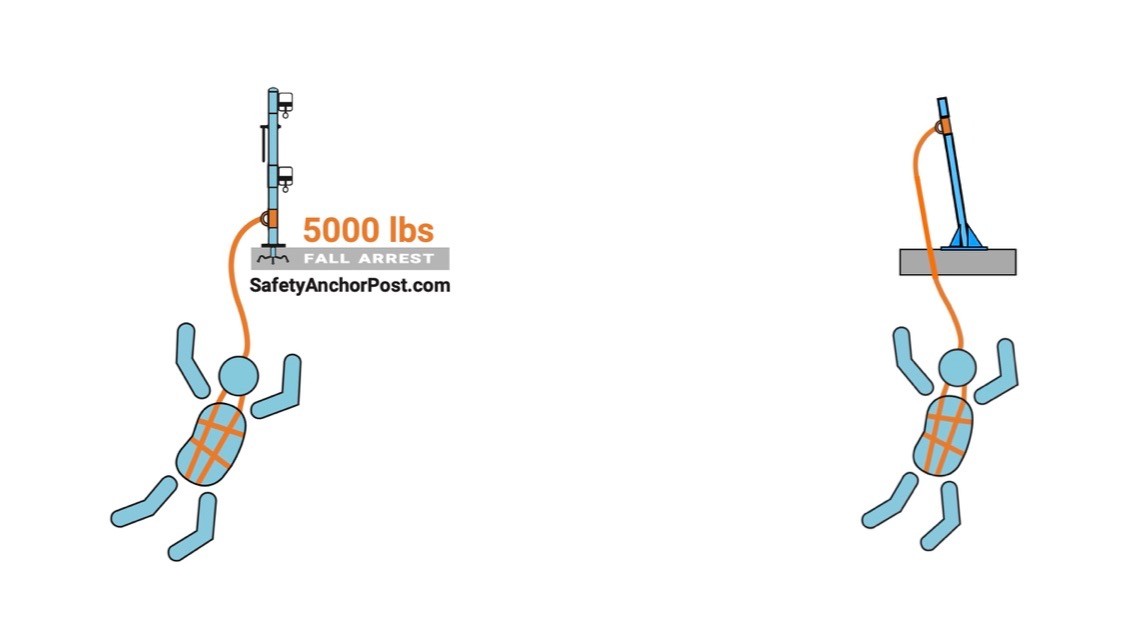
As the image below powerfully illustrates, the physics at play is simple yet devastating: M=F×d (Moment equals Force multiplied by the distance from the base).

The higher the attachment point (d) is positioned on the post, the exponentially greater the force (M) is applied to the base and the entire supporting structure. This is the dangerous Antenna Effect—it can cause catastrophic failure of the anchor post or the supporting structure itself, even when the anchor has a static rating of 5,000 lbs. A high static rating does not guarantee dynamic performance.
The Critical Difference: Engineering to Neutralize Catastrophic Failure
At Safety Anchor Post, we don’t just follow guidelines; we proactively engineer solutions that manage and mitigate the physics of a fall.
The Safety Anchor Post is engineered as an integrated system specifically to successfully neutralize the dangerous Antenna Effect. This is achieved by deliberately positioning the tie-off point lower on the post than typical, less-engineered designs.
This design choice is not arbitrary; it’s a calculated, life-saving measure. By minimizing the distance (d), we significantly reduce the moment (M) exerted on the post and its foundation. This is the only way to truly neutralize catastrophic failure at the base and provide the highest level of non-catastrophic protection for the worker.
Our commitment to this critical design difference ensures our posts are versatile for every critical application:
- PT Cable Decks & Existing Structures: Engineered for optimal load distribution, preventing damage to tensioned cables or compromised surfaces.
- Structural Steel & Bridges: Designed with robust, adaptable attachment methods (weld-on/bolt-on) that maintain the required safety factor without compromising the structural integrity of girders or beams.
- CLT (Cross-Laminated Timber): Specialized connection points engineered to transfer dynamic loads effectively, utilizing the material’s lateral shear capacity.
OSHA and ANSI: Understanding the Law vs. Life-Saving Performance
Our engineering philosophy is built on a clear understanding of how safety standards function in the real world:
1. OSHA: The Legal Foundation (The “Must Do”)
The Occupational Safety and Health Administration (OSHA) sets the minimum legal requirements for worker safety. OSHA standards are mandatory and legally enforceable.
- OSHA’s Role: It outlines what employers must do, such as providing fall protection at specific heights and requiring anchorage points to withstand a 5,000 lb. static load per worker (or a 2:1 safety factor for engineered, certified systems).
- The Challenge: While legally compliant, OSHA’s standards often represent a baseline. They may not fully account for the complex, dynamic forces generated in a real fall event, nor do they specify the engineering required to overcome challenges like the Antenna Effect.
2. ANSI: The Engineering Benchmark (The “How to Do It Better”)
The American National Standards Institute (ANSI), through its Z359 Fall Protection Code, sets voluntary consensus standards that represent the industry’s best practices for product performance, testing, and system design.
- ANSI’s Role: It guides manufacturers and safety professionals on how to go above the minimum, employing rigorous dynamic testing to ensure equipment performs effectively in real-world fall scenarios.
- Our Compliance: By meeting the stringent dynamic testing requirements of:
At Safety Anchor Post, we believe that OSHA compliance is just the starting point. Our engineering delivers the critical performance that saves lives when the “must do” isn’t enough.
The True Cost of Inadequate Anchors: Risk, Liability, and Operational Impact
For Operations Managers, Qualifiers, Quality Controllers, and Procurement Departments, the choice of fall protection goes beyond a simple purchase order. The failure of an anchorage system carries immense financial, legal, and operational consequences:
- Unacceptable Liability: Beyond the immeasurable human cost, a catastrophic failure triggers immediate work stoppage, extensive OSHA investigations, punitive fines, and potential long-term liability, often citing the OSHA General Duty Clause (which frequently references ANSI consensus standards as ‘recognized hazards’).
- Project Delays & Reputational Damage: Incident investigations halt operations, impacting project timelines and budget. Such events also damage your company’s reputation as a safe employer.
- Risk Mitigation: Investing in an engineered system like the Safety Anchor Post is a direct, proactive investment in risk mitigation and liability defense. It demonstrates due diligence in providing the safest possible work environment.
Seamless Integration into Your Safety Program
We understand that a superior anchor must also be practical and integrate efficiently into your existing safety management program:
- Managed Fall Protection Programs: The Safety Anchor Post is designed for easy integration into a comprehensive Managed Fall Protection Program (aligned with ANSI Z359.2).
- Eliminating User Error: We provide clear documentation for installation by a Qualified Person and distinctive demarcation of the tie-off point to minimize the potential for user error.
- Facilitating Rescue & Retrieval: In the event of a fall, our robust design with a post-level tie-off pointsignificantly aids smoother rescue and retrieval operations. This eliminates many of the common challenges associated with anchoring into distant, recessed floor-level points, supporting compliance with ANSI Z359.4(Requirements for Assisted-Rescue and Self-Rescue Systems, Subsystems and Components).
Elevate Your Fall Protection Strategy
Don’t settle for “good enough” when lives are on the line. Understanding and mitigating the “Antenna Effect” is paramount to preventing catastrophic failures.
Safety Anchor Post offers not just compliance, but confidence—engineered protection that performs when it matters most.
Ready to see the critical difference?
- Contact us today for detailed specifications and engineering documentation.
- Visit our website at safetyanchorpost.com to learn more.
- Download our technical white paper on the “Antenna Effect” and advanced anchorage design.